
Attendance and Absence
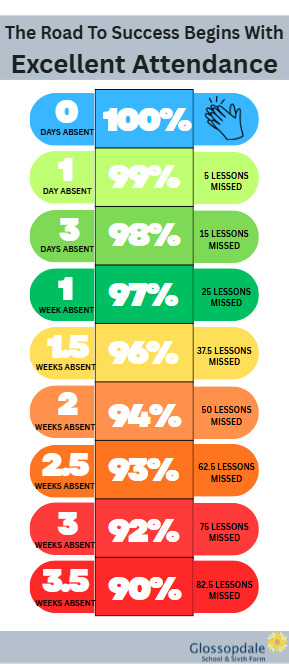
Attendance at Glossopdale School & Sixth Form
At Glossopdale School & Sixth Form, we know that excellent attendance is the key to helping our students succeed. For us, excellent attendance means being in school 100% of the time, and we ask all students to aim for at least 97% attendance.
Being in school every day gives students the best chance to enjoy our broad curriculum, build strong friendships, and THRIVE both academically and personally.
We value our partnership with parents and carers, and we’re here to work together to overcome any challenges that might affect regular attendance. By offering early help and support, our aim is to make sure every student can achieve excellent attendance and reach their full potential.
The Impact of Absence
Even small amounts of time away from school can add up and have a real impact on learning. For example, 95% attendance might sound high, but it actually means around 10 days or 50 hours of lost learning over the year.
Research by the Department for Education shows just how important excellent attendance is:
- Students with excellent attendance are 1.9 times more likely to achieve a Grade 5 in English and Maths compared to those whose attendance drops below 95% (DfE, March 2025).
- Every 5% drop in attendance can lead to students achieving up to half a grade lower than their predicted results.
Put simply, students who attend school every day are far more likely to reach their full potential and achieve stronger academic outcomes. Regular attendance really does make a big difference.
How Do I Report My Child’s Absence?
If your child is unable to attend school, please let us know as soon as possible on the day of the absence, and no later than 8.15am. We ask that parents and carers contact us every day their child is absent, unless school advises otherwise.
You can report a student’s absence in the following ways:
Call Us:
Phone: 01457 862336
Select Option 1 → Option 1
Please leave a message including:
- Your child’s name
- Their year group
- The reason for their absence
Email the Year Team
You can also report an absence by emailing the relevant year team:
- Year 7: year7absence@glossopdaleschool.org.uk
- Year 8: year8absence@glossopdaleschool.org.uk
- Year 9: year9absence@glossopdaleschool.org.uk
- Year 10: year10absence@glossopdaleschool.org.uk
- Year 11: year11absence@glossopdaleschool.org.uk
Your email should include:
- Your child’s name
- Their year group
- The reason for their absence
Absence for Minor Ailments
We encourage students to attend school if they have minor ailments that can be managed with simple, over‑the‑counter remedies such as mild headaches, colds, or stomach aches. Absences for these minor issues will not usually be authorised.
If you’re ever unsure whether your child is well enough to come into school, please get in touch with us. We’re always happy to offer advice and support.
You can also find helpful guidance on the NHS website: Is my child to ill for school?
Absence for Illness
If your child is genuinely unwell and unable to attend school, we will record the absence using an I code (Illness).
For illnesses that last three days or more, we ask parents and carers to provide medical evidence so that the absence can be authorised.
Acceptable forms of medical evidence include:
- A GP appointment card or confirmation of an appointment
- A copy of a prescription
- Medication packaging showing the child’s name and date
- A hospital appointment letter or discharge letter
- A note from a healthcare professional
- Evidence of NHS 111 advice
Providing this information helps us ensure that absences are recorded accurately and that we can support your child’s return to school as soon as they are well enough.
Daily Attendance Protocols
At Glossopdale School & Sixth Form, we follow a clear set of attendance procedures designed to monitor absence, offer timely support, and work closely with families to help every student achieve excellent attendance.
These processes are fully aligned with the Trust Attendance Policy, which you can read in full here.
Our protocols outline the steps we may take to check and discuss absence, identify barriers to attendance, and provide the right support at the right time.
Morning Attendance Calls (AM)
Each morning, our Attendance Team will contact parents and carers regarding any student who is absent from school.
These calls allow us to:
- Follow-up all student absences and absence calls/emails
- Understand the reason for non‑attendance
- Encourage students to return to school as soon as they are able to do so
We prioritise families who have not contacted us first, but we aim to follow up with all student absences each morning.
Afternoon Attendance Calls (PM)
In the afternoon, we make courtesy calls to check in on students who have been absent for any reason.
These calls help us to:
- Offer support
- Monitor a student’s wellbeing
- Encourage a prompt return to school
This approach has been shown to significantly reduce unnecessary, multi‑day absences, help students to get back into routine quickly and significantly reduce any missed learning.
Attendance & Wellbeing Visits
Sometimes we may need to carry out an Attendance & Wellbeing Visit. These visits are an important part of how we work with families to understand any challenges and support students back into regular attendance.
We may complete a visit if:
- We have not received an explanation for an absence from school
- A student has been absent for three or more days, even if we have already been in contact or received medical evidence
- We have any concerns about a student’s attendance, wellbeing, or engagement
These visits help us to:
- Understand any difficulties that may be affecting attendance
- Offer early help and intervention where needed
- Strengthen communication and partnership between home and school
- Check on a student’s wellbeing or safety
Where possible, we will contact parents and carers beforehand to arrange a time that works for everyone. However, please be aware that unannounced visits may take place if:
- We have significant concerns
- We have been unable to make contact
- The reason for absence is still unclear
Our aim is always to work together with families to ensure students are safe, supported, and able to return to school confidently.
Strategies & Interventions to Support Improved Attendance
At Glossopdale School & Sixth Form, we are committed to working closely with students and their families to help improve attendance and remove any barriers that may be getting in the way. The support we offer may include:
- Informal and formal attendance meetings with the Pastoral Team, Attendance Manager, or Senior Leadership Team
- Pastoral support, such as mentoring, check‑ins, or wellbeing interventions
- Individualised attendance improvement plans tailored to each student’s needs
- Referrals to external support services where appropriate
- Regular rewards and recognition to celebrate improved or excellent attendance
By working together, we can help every student engage fully in their learning, feel supported, and achieve their full potential.
How we Monitor Attendance: A‑Star Attendance
A Star Attendance is a digital system that helps schools monitor attendance, spot concerns early, and communicate clearly with families using real‑time data and automated updates.
We use A Star Attendance to formally monitor and track student attendance throughout the year. This system helps us quickly identify any emerging patterns, respond promptly to concerns, and ensure our records are accurate and up to date.
Through A Star Attendance, we send digital attendance letters to parents and carers. These may include:
- General updates about your child’s attendance
- Notifications if we are starting to see concerns
- Formal warnings or required actions if attendance falls below expected levels
Using this system ensures that communication is clear, timely, and consistent. It also helps us put early support in place so we can work together to improve attendance before issues escalate.
How Can I Monitor My Child’s Attendance?
Parents and carers can easily keep track of their child’s attendance through the MyChildAtSchool (MCAS) app. MCAS gives you real‑time information about your child’s attendance percentage, their daily attendance marks, and any authorised or unauthorised absences.
We encourage families to check the app regularly so that any issues can be spotted early and dealt with quickly. If you ever have questions about what you’re seeing on MCAS, or if you need help logging in or accessing your account, please contact school - we’re always happy to support.
Legal Framework
Attendance isn’t just vital for your child’s learning and wellbeing — it is also a legal requirement.
Under the Education Act 1996, parents have a legal duty to make sure their child receives full‑time education that is suitable for their age, ability, and individual needs. This normally means attending school regularly.
Schools are required to keep accurate attendance records and follow national guidance when dealing with non‑attendance. When a child’s attendance drops below 95%, schools may need to refer parents and carers to the local authority for formal monitoring. In some cases, this can lead to a Fixed Penalty Notice being issued, and further legal action may follow if attendance does not improve.
Our aim is always to work with families early and supportively to prevent absence reaching this stage.
Leave of Absence
The law allows children to take time off school only in genuinely exceptional circumstances. If you need to request leave, please complete our leave of absence request form here:
All requests are considered individually, and approval is at the school’s discretion.
Term-Time Holidays
Please note that term‑time holidays cannot be authorised under any circumstances.
Family holidays, travel abroad, or visits to relatives are not considered exceptional, so these absences will be recorded as unauthorised.
In line with local authority procedures, unauthorised holiday absence may result in a referral to the Local Authority, which will lead to a Fixed Penalty Notice (FPN) being issued. Fixed Penalty Notices are issued by the Local Authority and cannot be appealed.
Ceremonial Events
Requests for important family or cultural events such as weddings, funerals, or significant religious or cultural observances will be considered on a case‑by‑case basis.
Where authorised, these absences are usually limited to 1–2 days, depending on the event and the travel required. Additional time for extended celebrations or long trips will not normally be approved.